Let your data tell you what to fix.
Your preference cards already contain the answers — which items never get opened, where duplicates hide, what other surgeons are doing differently with the same procedure. PREFcards' AI surfaces those patterns automatically, so your team can focus on reviewing the suggestion, not finding it.
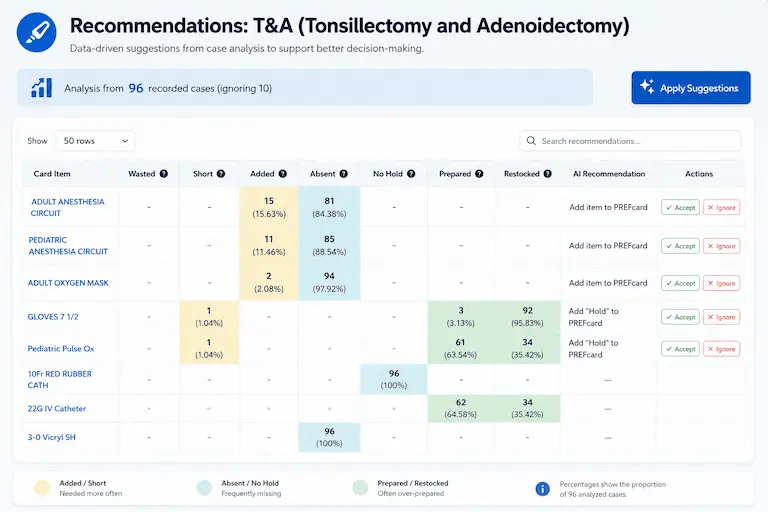
You can't audit thousands of cards. The AI can.
Every preference card carries history — a forgotten item that lingered from a retired surgeon's preferences, an expensive supply that's never actually opened, a setup convention that drifted from what the rest of the OR does. With hundreds or thousands of cards across a surgical program, manually auditing every line is impossible. So the inefficiency stays, quietly compounding across every case.
AI Card Suggestions changes that. It analyzes the actual data your OR is already generating — what gets opened, what gets returned to inventory, what other surgeons do for the same procedure — and surfaces the changes that would have the biggest impact. You stay in control of every change; the AI just makes sure nothing slips through.
Analyze. Suggest. Approve.
- 1
Analyze actual case data.
PREFcards continuously tracks what gets opened, what gets returned, what gets substituted at the case level. The AI uses that real usage data — not theoretical assumptions — to model how each card is actually performing.
- 2
Surface the highest-impact suggestions.
The AI flags items with zero or near-zero open rates, identifies duplicate items, finds expensive supplies that have cheaper equivalents already in use elsewhere, and points out where one surgeon's setup is meaningfully more efficient than peers' for the same procedure.
- 3
Review and approve with one click.
Every suggestion includes the data that triggered it. You decide what to apply and what to skip — the AI never changes a card without your sign-off. Approved changes propagate to all affected cards instantly.
The hidden inefficiencies AI Card Suggestions surfaces.
Items that never get opened
Supplies that have appeared on cards for months or years with zero open rates — quietly costing money on every case they're picked.
Duplicate items
The same item appearing twice on the same card under slightly different names, or equivalent items duplicated across the supply list.
Cheaper substitutes already in use
When another surgeon on the same procedure uses a lower-cost equivalent successfully, the AI flags the swap opportunity.
Standardization opportunities
Procedures where surgeon-to-surgeon variance is high but clinical outcomes are equivalent — prime candidates for standardization conversations.
Returned-to-inventory patterns
Items that get picked, opened, and returned at high rates — signaling cards that need attention to reduce waste.
High-cost outliers
Premium-priced supplies appearing on cards where the surgeon's case mix doesn't actually require them — easy wins for cost reduction.
Let the data work for your OR.
See AI Card Suggestions — and the rest of PREFcards — in a 30-minute walkthrough tailored to your facility.
Book a demo